Hospital Procurement Process: Steps, Medical Tenders & Supplier Evaluation
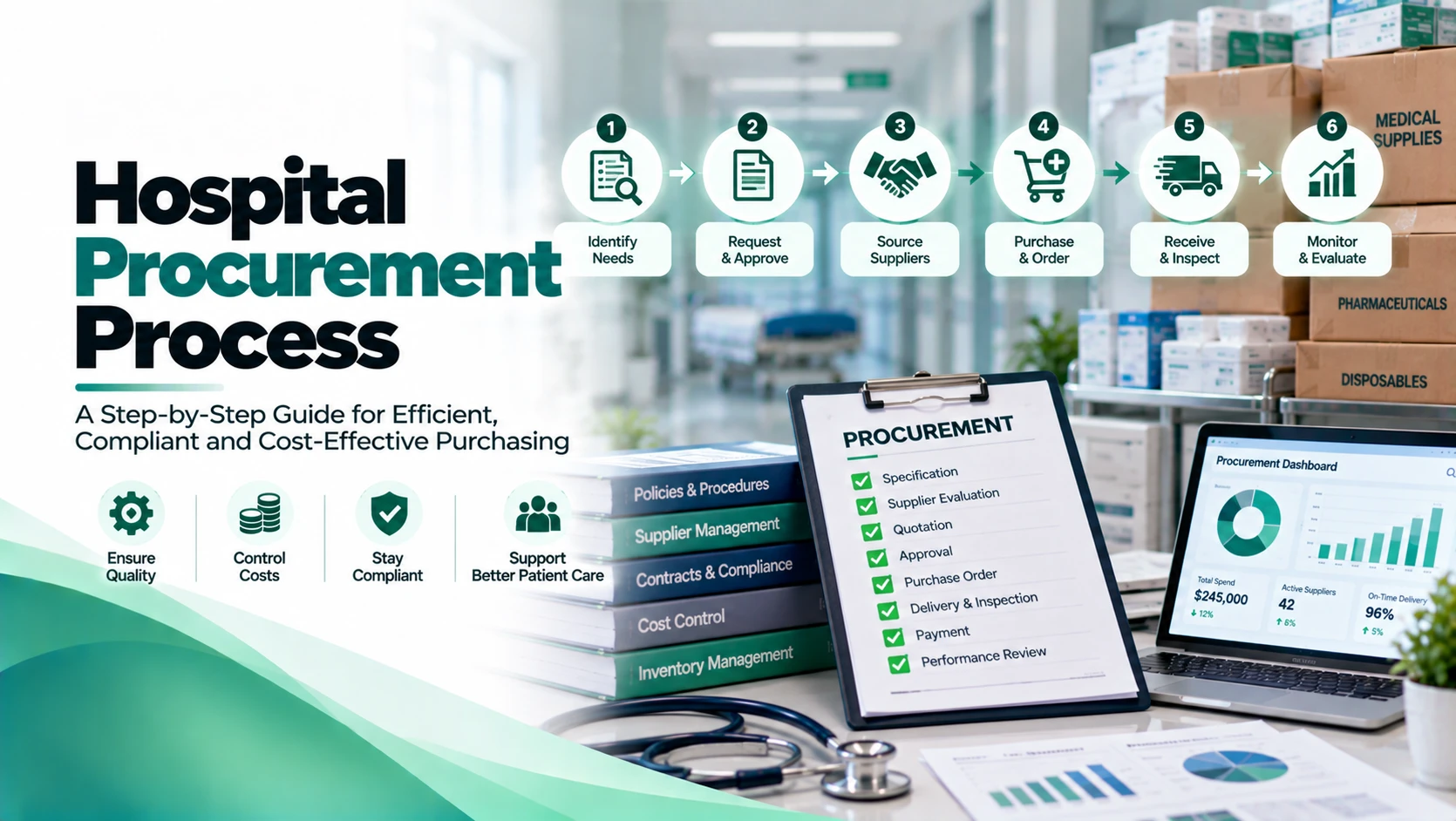
Good hospital procurement isn't about finding the cheapest price. It's about getting the right product, reliably, at the best total cost. Here's the full process, from the first requisition to supplier review.
In this article
- The 8 steps of the hospital procurement process
- 1. Identify and approve the need
- 2. Write the specification
- 3. Source suppliers
- 4. Choose the purchasing method
- 5. Run the tender and evaluate bids
- 6. Award and negotiate
- 7. Contract
- 8. Review supplier performance
- How to evaluate suppliers: a weighted scorecard
- Group purchasing and standardization
- Common hospital procurement mistakes
- Keep reading
- Hospital procurement runs in eight steps: need, specification, sourcing, tender or RFQ, evaluation, award, contract and performance review.
- Clear, clinically agreed specifications prevent most later disputes.
- Evaluate tenders on technical quality first, then price. Two-envelope evaluation makes this easier.
- Score suppliers on weighted criteria (quality, delivery, price, service, compliance), not on habit.
- Group purchasing and standardization strengthen your negotiating position.
Procurement decides what reaches the shelf. If it goes wrong, no amount of inventory control will fix it: the wrong product, an unreliable supplier or a contract with no penalties will show up later as stock-outs, complaints and higher costs.
This guide walks through the hospital procurement process step by step, with practical tools for medical tenders and supplier evaluation.
The 8 steps of the hospital procurement process
1. Identify and approve the need
Every purchase starts with a need: replenishing a stocked item, a new product requested by clinicians, or new equipment. Check whether an existing contract or product already meets it before buying something new.
2. Write the specification
The specification describes what you need, not which brand. A good specification covers:
- Clinical and technical requirements (sizes, materials, sterility, compatibility)
- Regulatory requirements (registration with the national health authority, certificates)
- Packaging, labeling, shelf life on delivery and storage conditions
- Training, installation, maintenance and spare parts (for equipment)
Write specifications with the clinical users who will use the product. Most later disputes come from vague specs.
3. Source suppliers
Identify qualified suppliers: registered distributors, manufacturers' agents and approved vendors. For vital items, try to keep at least two qualified sources.
4. Choose the purchasing method
| Method | When it's used |
|---|---|
| Open tender | High-value or long-term contracts, open to all qualified suppliers |
| Limited (restricted) tender | Specialized products with a known, small supplier pool |
| Request for quotation (RFQ) | Lower-value purchases with clear specifications |
| Direct purchase / single source | Genuinely unique products, or justified emergencies |
Public hospitals must follow their national procurement rules and e-procurement platforms (for example, Etimad in Saudi Arabia). Private hospitals usually set their own thresholds in a procurement policy.
5. Run the tender and evaluate bids
Many hospitals in the region use two-envelope evaluation:
- Technical envelope first. Does the bid meet the specification? Check samples, certificates, registration, clinical trial use and the supplier's capability.
- Financial envelope second. Open prices only for technically compliant bids.
This stops a low price from distracting the committee from quality. Keep a clear, documented scoring sheet, and make sure committee members declare any conflict of interest.
6. Award and negotiate
Award to the best-value compliant bid. Negotiate on more than price: delivery lead time, consignment stock, payment terms, free training, warranty, price validity and pack sizes all have real value.
7. Contract
A solid supply contract includes:
- Product, specification, price and price-validity period
- Delivery lead time, delivery location and minimum shelf life on delivery
- Penalties for late or incomplete delivery, and the right to buy elsewhere at the supplier's cost
- Recall, return and replacement terms (including near-expiry returns)
- Quality complaints process, and the KPIs you'll measure
8. Review supplier performance
Procurement doesn't end at the contract. Measure every supplier, review the results quarterly, and use them in the next tender.
How to evaluate suppliers: a weighted scorecard
Score each supplier from 1 to 5 on each criterion, multiply by the weight, and add up the results.
| Criterion | Weight | Supplier A | Supplier B |
|---|---|---|---|
| Product quality and complaints | 30% | 4 | 3 |
| Delivery reliability (OTIF, lead time) | 25% | 3 | 5 |
| Price and total cost | 20% | 5 | 3 |
| Service and support | 15% | 3 | 4 |
| Compliance and documentation | 10% | 4 | 4 |
| Weighted score (out of 5) | 100% | 3.80 | 3.75 |
Supplier A wins narrowly on these weights. If delivery reliability mattered more (for vital items, say), Supplier B could come out ahead. That's why the weights should be agreed before you score.
Use real data in the scorecard
Delivery reliability should come from measured OTIF and lead times, not impressions. See healthcare supply chain KPIs for the formulas.
Group purchasing and standardization
Two of the most powerful cost levers in hospital procurement:
- Standardization: agree with clinicians on fewer brands and sizes for the same need. Fewer items means higher volumes per item, better prices and simpler inventory.
- Group purchasing: combine demand across departments, hospitals in a group, or a purchasing consortium to negotiate volume-based prices and better terms.
Common hospital procurement mistakes
- Awarding on price alone, then paying for it in failed deliveries and complaints.
- Vague specifications that let non-equivalent products win.
- Emergency buying as routine, which signals a planning or inventory problem upstream.
- Contracts with no service levels or penalties.
- No supplier performance data when the contract comes up for renewal.
Master hospital procurement and tendering
Module 2 of the Healthcare Supply Chain Course covers sourcing medical supplies and equipment, tendering and contracting, supplier evaluation, and group purchasing and cost negotiation.
Prefer a focused, single-topic track? See our Healthcare Procurement guide.
What are the steps of the hospital procurement process?
Identify and approve the need, write the specification, source suppliers, choose the purchasing method (tender, RFQ or direct purchase), evaluate bids, award and negotiate, sign the contract, and review supplier performance.
What is a two-envelope tender?
A tender where suppliers submit technical and financial offers separately. The committee evaluates technical compliance first and opens the prices only for bids that pass, so quality isn't overshadowed by price.
How do you evaluate medical suppliers?
Use a weighted scorecard covering product quality, delivery reliability (OTIF and lead time), price and total cost, service, and compliance. Base the scores on measured data and review them at least quarterly.
What is group purchasing in healthcare?
Combining purchasing volumes across departments, hospitals or a consortium to negotiate better prices and terms with suppliers.
Where can I study hospital procurement online?
Medicova's Healthcare Supply Chain Course includes a full module on healthcare procurement and vendor management, taught in English and Arabic, with a certificate of completion.
Keep reading
 M
Written by
Medicova Editorial Team
View profile & articles
